


Scroll Down
Scroll Down
Scroll Down
What equipment do we supply?
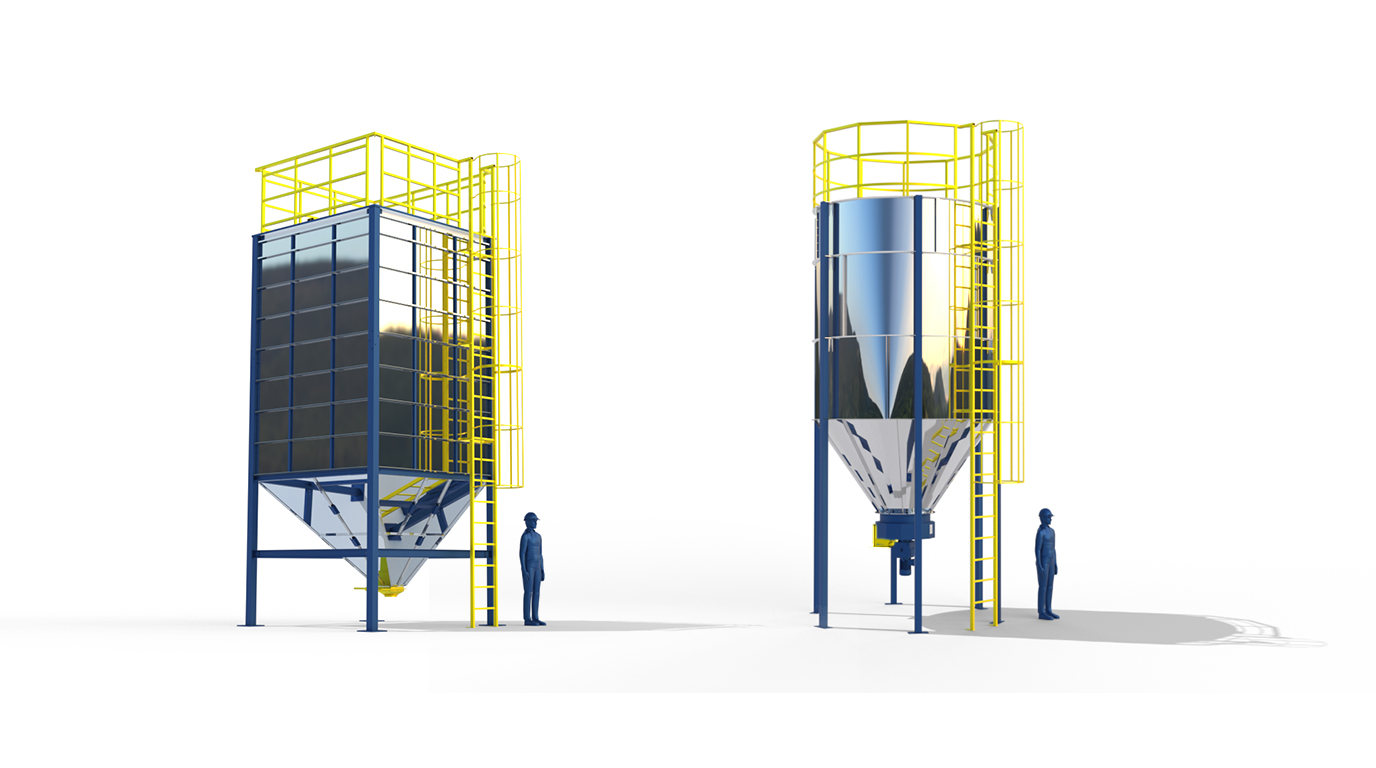
Silos and Tanks
What are industrial silos and tanks used for?
Industrial silos and tanks are vertical or horizontal storage devices designed for storing, warehousing, and controlled transport of bulk materials, liquids, and gases.
Their basic functions include:
Material Protection
Tanks protect stored raw materials from harmful atmospheric conditions, moisture, extreme temperatures, and pest activity. Special construction maintains optimal storage conditions for long-term material storage without risk of quality loss.
Space Saving
Silos occupy relatively little floor space compared to traditional warehouses of similar capacity. Thanks to vertical orientation, they utilize vertical rather than horizontal space.
Logistics Facilitation
Gravity and pneumatic unloading systems enable easy loading and unloading of materials, minimizing physical work and reducing handling time.
Quality Control
Built-in ventilation and aeration systems maintain constant humidity and temperature conditions, preventing mold, material caking, and oxidation of stored products.
How do industrial silos and tanks work?
The operation of silos is based on a combination of physical, mechanical, and pneumatic processes.
Filling
Material is loaded into the silo through an upper opening pneumatically via compressed air or gravitationally through loading funnels. Pneumatic filling systems are particularly effective for dusty materials, where automatic systems reduce losses and dust inhalation.
Storage and Environmental Control
During storage, ventilation and aeration systems work automatically, supplying air to the bottom of the tank.
The process is controlled through:
Ventilation Systems
Maintain air flow preventing material caking.
Humidity Regulators
Reduce humidity below critical levels, e.g., below 15% for biomass.
Temperature Sensors
Monitor potential hazards especially in biomass silos.
Unloading
The process relies on gravity and pneumatics.
In funnel silos, material flows naturally under gravity through a conical bottom at a 45-degree angle. Aeration systems, i.e., air flushing in the funnel, assist material flow, especially for difficult-to-unload products. Pneumatic unloading systems use compressed air to transport material through pipelines to a receiver. Pneumatic selectors, i.e., pneumatic hammers, remove blockages and material bridges that can prevent free falling. Mechanical selectors, i.e., screw type, empty silos storing materials with low bulk density like sawdust and chips.
Technical Specifications
Construction Materials
Carbon steel is universal and durable but susceptible to corrosion and requires protection.
Stainless steel (1.4301) features high corrosion resistance and is designed for contact with aggressive substances, though more expensive.
Aluminum is lightweight and corrosion-resistant but has lower strength, so it works mainly in transport and mobile tanks.
Protective coatings are used for corrosion protection, especially for carbon steel, e.g., anti-corrosion coatings, galvanization.
Dimensions and Capacities
Silos are available in a wide range of dimensions. Diameter range of 1.0 - 5.6 meters. Height range of 2.0 - 15.0 meters.
Components and Construction Features
Basic elements:
Cylindrical walls. Corrugated sheet 2-3mm thick reinforced with horizontal and vertical rings.
Bottom/Funnel. 45° inclination angle enables natural material flow.
Roof. 100mm thick mineral insulation and trapezoidal aluminum galvanized covering.
Internal pipelines. Stainless steel for ventilation systems.
Support. Omega profiles and M8, M10 screws with protective coatings.
Auxiliary systems:
Ventilation and aeration systems with air vents
Dust filtration, i.e., bag filters, pulsation elements
Unloading systems, i.e., screw, chain, rotary feeders
Inspection ladders and inspection windows
Temperature and humidity sensors for biomass and sensitive products
Safety valves and relief valves
Applications in Individual Industries
Agricultural Industry
Grain storage, i.e., wheat, corn, rapeseed, soybeans. Animal feed warehousing. Fertilizer and pesticide storage. Silos equipped with ventilation systems preventing mold and decomposition.
Wood and Biomass Industry
Silos for storing sawdust and wood chips. Wood fuel warehousing, i.e., pellets, wood waste. Biomass silos in energy installations. Special functions such as humidity control systems below 15%, temperature sensors, fire suppression and venting systems. Usually equipped with screw or chain systems for unloading.
Chemical Industry
Powder and granule warehousing. Chemically aggressive substance storage. Silos made of stainless steel or with special protective coatings.
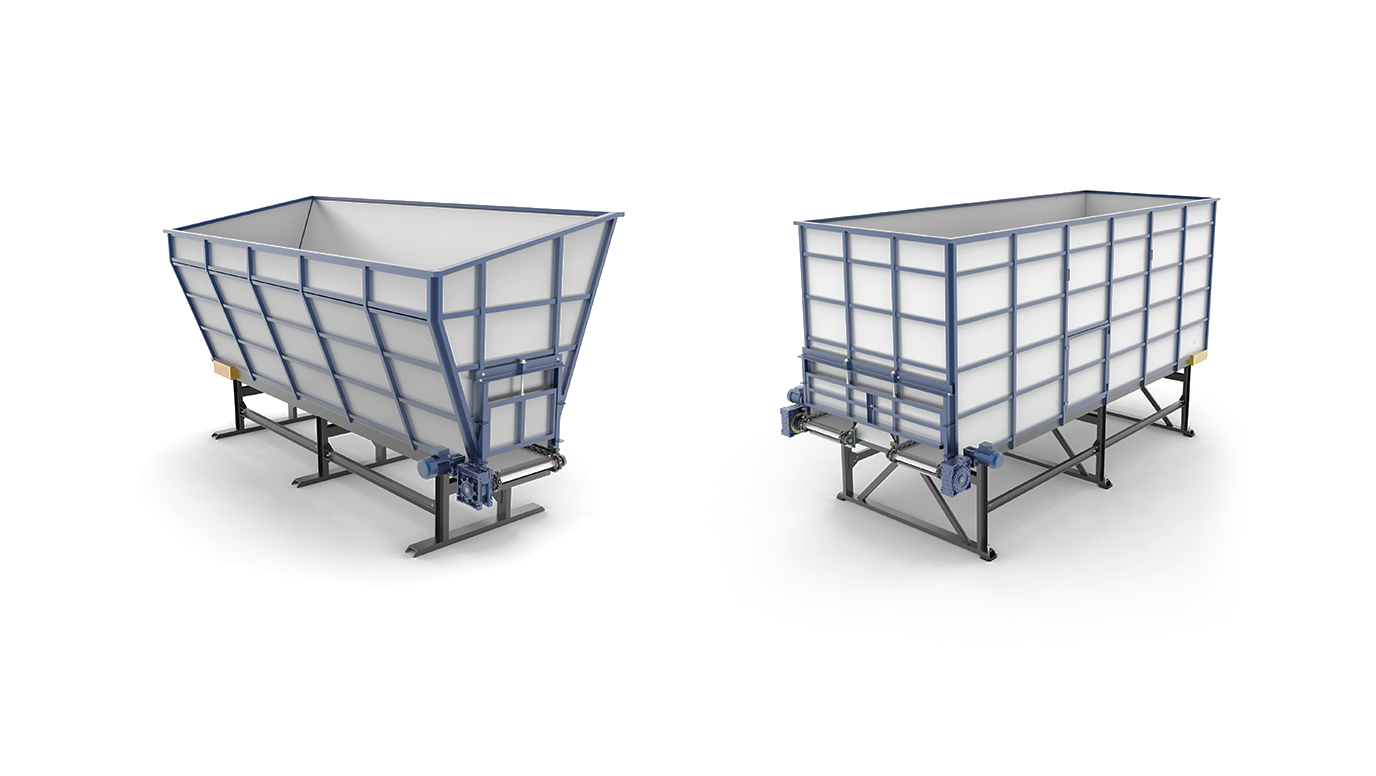
Container with Walking Floor
Machine Purpose
A container with walking floor is a modern storage and feeding device designed for uniform and controlled dispensing of various types of bulk materials. The device is used for handling materials such as sawdust, wood chips, beet and corn pulp, or alternative fuels like RDF. The construction of the walking floor container enables stable and continuous material feeding to technological receivers, ensuring high reliability and process repeatability.
Operating Principle
The feeding mechanism of the walking floor container works as follows.
An electric motor through a combined reduction gearbox rotates the drive shaft. Steel sprocket wheels are mounted on the shaft, whose profile during rotation forces the movement of chains connected with scrapers. Material is moved to the discharge point. In the rear part of the hopper is a tension shaft with two bushed guide wheels, and chain tension adjustment is done using two tensioning screws.
Technical Specification
A walking floor container is a welded massive steel structure with a dense arrangement of load-bearing profiles. Depending on technological requirements, internal surfaces can be finished with stainless steel sheet (1.4301) or galvanized sheet.
The main part of each hopper consists of four welded steel wall frames, floor frames (in quantities depending on the number of material-moving mechanism sections), and connecting (assembly) frames welded to the floor frames.
Model ZS-4 is the smallest version with 4 m³ capacity, compact dimensions and 0.75 kW drive power, equipped with one feeding section – designed for small installations. ZS-6 offers 6 m³ capacity, greater length and 1.1 kW power, still with one section, making it an intermediate solution for small loads. ZS-11 is a medium model with 11 m³ capacity, larger dimensions and 1.1 kW power, suitable for more intensive work while maintaining one feeding section.
Models ZS-17 and ZS-30 are designed for larger applications, having 17 and 30 m³ capacity respectively, two feeding sections, and increased drive power of 2 × 1.5 kW and 2 × 2.2 kW respectively, ensuring more efficient material transport.
The largest model, ZS-90, offers as much as 90 m³ capacity, four feeding sections and 2 × 3 kW drive, making it adapted for work in large industrial and agricultural installations with high capacity.
All walking floor container models have a chain breaking load of 9000 kg.
Machine advantages are:
Uniform and stable material transport
High resistance to overloading and clogging
Simple chain tension adjustment
Easy service access to drive elements
Long service life thanks to solid chains and massive construction
Rigid, welded construction with dense arrangement of load-bearing profiles
Possibility of finishing interior with stainless or galvanized sheet
Modular construction easily adapted to installation conditions
Convenient access through wide inspection doors
Smooth internal surfaces facilitating cleaning and limiting material retention
Applications in Individual Industries
Agricultural Industry
Storage and feeding of beet and corn pulp.
Wood and Biomass Industry
The most important application, including sawdust and wood chip transfer between production stages.
Energy
Handling alternative fuels like RDF (Refuse-Derived Fuel), i.e., waste-derived fuels.
Other Applications
Due to construction versatility, walking floor containers can handle various bulk materials in the chemical, pharmaceutical, construction, or recycling industries.
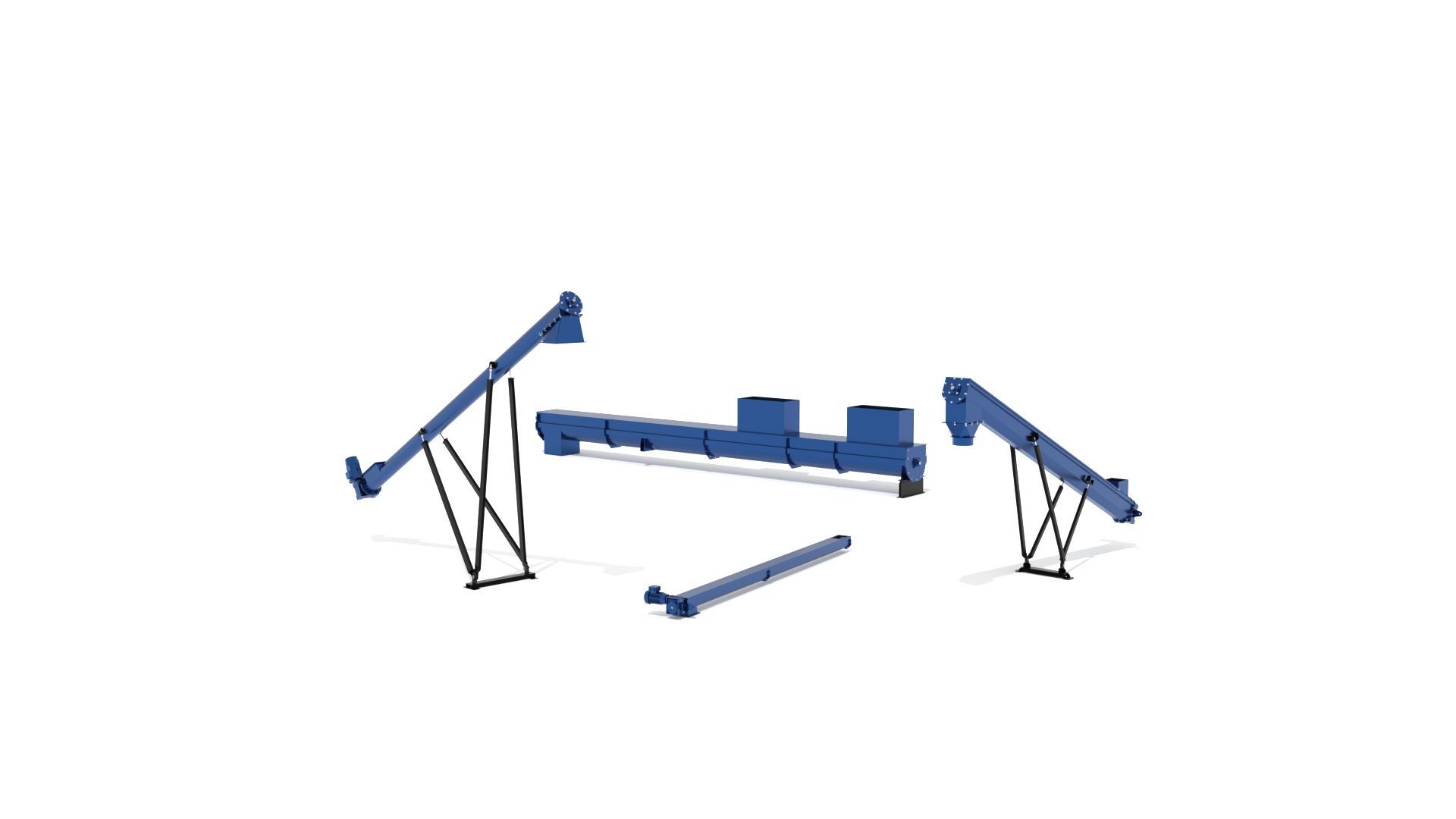
Screw Conveyors
Machine Purpose
A screw conveyor, also called a screw feeder or auger, is a device designed for efficient transport of bulk materials over short and medium distances. The basic purpose of the machine is to move raw materials horizontally, at an angle, or vertically, making it a universal transport solution. Besides transport, screw conveyors also perform product dosing functions in technological processes, material mixing, and sludge transport. Thanks to closed construction, transported material can be isolated from the environment, which is particularly important in industries requiring sterility and safety.
Operating Principle
The operating principle is based on rotary motion of the screw, whose drive is realized by a motor with gearbox. Inside the housing is a screw shaft on which a spiral surface called screw ribbon is wound. As the shaft rotates, screw flights with special spiral shape catch material and move it along the trough housing. The process is intuitive. Material in the form of grain, flour, seeds, gravel, or sand is introduced to the feeder through a hopper. Then the rotating shaft causes transported material to move to the outlet point. This mechanism is based on the Archimedes screw principle, guaranteeing stable and predictable operation regardless of transported material type.
Technical Specification
A screw conveyor consists of the following key elements:
Working trough is the main housing, usually U-shaped or tubular
Feeding hopper is the material entry point
Screw shaft is a tube connected with wound spiral, i.e., screw ribbon
Nozzles are material inlet and outlet
Drive is motor with gearbox
Bearings are shaft support
Covers are in closed versions
Construction Materials
Screw conveyors are made of high-quality materials ensuring durability and resistance:
Carbon steel is grades C1020, C1040, C1045, C4140 are most commonly used
Stainless steel is 304 and 316 ideal for humid and corrosive environments
Wear-resistant steels for applications requiring abrasion resistance
Monel and other special alloys for demanding work conditions
Plastics for specialized applications
Applications in Individual Industries
Agricultural Industry
On farms, screw conveyors serve to transport grain, seeds, and feed. Devices are used for loading, unloading, and grain transport between machines, as well as for animal feed dosing. They can also transport other bulk materials such as mineral fertilizers or feed semi-finished products.
Wood and Biomass Industry
Screw conveyors play a key role in sawdust and chip transport. In furniture factories and sawmills, devices transport bulk wood waste to fuel silos or for further processing. In paper mills, screws transport wood material from the yard to the digester where it's processed into pulp. In renewable energy, wood biomass is transported to heating boilers where it serves as fuel for steam and electric power production.
Energy
In biomass-fired power and heating plants, screw conveyors transport wood fuel from warehouses to furnaces, and also transport ash from furnaces to waste containers. These systems work continuously and reliably, which is a necessary condition for strategic energy equipment.
Chemical Industry
Devices transport chemical raw materials and preparations, especially in powder and granule form. Closed construction ensures operator safety and prevents environmental contamination.
Construction Industry
Conveyors transport cement, sand, gravel, and other bulk materials at construction sites and in cement plants and grinding facilities. Devices speed up the loading and unloading process and automate deliveries to mixers.
Recycling and Waste Management
In recycling plants and wastewater treatment installations, screw conveyors transport sludge, waste, and materials returning to production. They are particularly useful for sticky, wet, and difficult-to-transport materials.
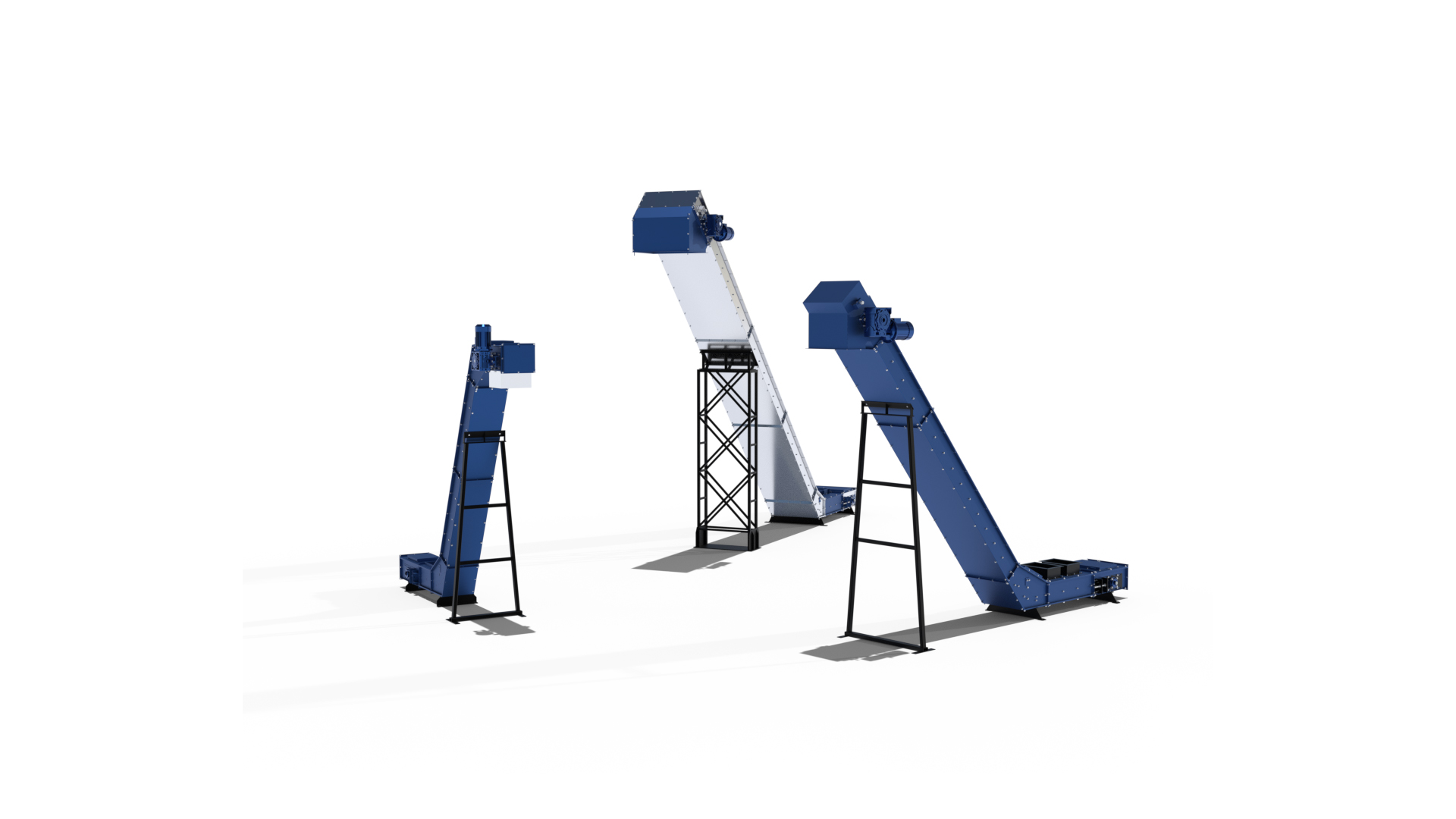
Scraper Conveyors
Machine Purpose
Scraper conveyors, also called drag conveyors, are transport devices designed for continuous transfer of bulk materials inside a closed trough. The main task of the machine is efficient transport of various raw materials and products over medium to long distances, both horizontally and at an angle, even vertically.
Devices work especially well when transporting materials with higher moisture content, irregular granulation, and in demanding work conditions, ensuring system tightness and limiting dust emission. The possibility of loading and unloading at any point along the route is an additional advantage of this design.
Operating Principle
A scraper conveyor works based on the following mechanism.
Action structure:
An electric or hydraulic motor drives sprockets that move two endless chains connected with scrapers
Chains along with scrapers move inside the conveyor trough
Scrapers push material along the trough bottom, moving it away from walls and shifting it toward the outlet
Chain speed is regulated depending on transported material type and required capacity parameters, which also enables material dosing.
Technical Specification
Scraper conveyors are made of materials ensuring high durability and reliability. Chain components, i.e., pins, bushings, bolts, axles, are made of special steels with heat treatment to achieve required hardness and strength.
Construction Materials
Carbon steel as basic construction material
Acid-resistant steel for applications requiring corrosion resistance
Sliding plates or basalt lining as friction and wear reduction elements
Chains of fully welded steel, heat-treated
Replaceable slides and guide rollers reducing wear
Applications in Individual Industries
Agricultural Industry
Transport of grain, hay, seeds. Agricultural product processing lines. Animal feed preparation.
Wood and Biomass Industry
Transport of sawdust and wood byproducts. Pellet and briquette production lines. Biomass processing for heating purposes.
Energy
Transport of biomass (sawdust, pellets, chips) to boilers. Transport of ash and slag from electrostatic precipitators. Energy furnace feeding systems.
Chemical Industry
Transport of synthetic fertilizers, salts. Transport of cement, lime. Transport of fine-grained substances.
Construction Industry
Transport of rubble and building materials. Construction waste processing. Derivative material preparation.
Recycling and Waste Management
Municipal waste processing systems. Waste fraction transport. Recycling lines.
Mining and Quarries
Transport of extracted coal, ore, stone. Underground mining work. Mineral resource exploitation.
Metallurgical and Metal Industry
Transport of slag, ash, metal chips. Metal recycling. Scrap processing stations.
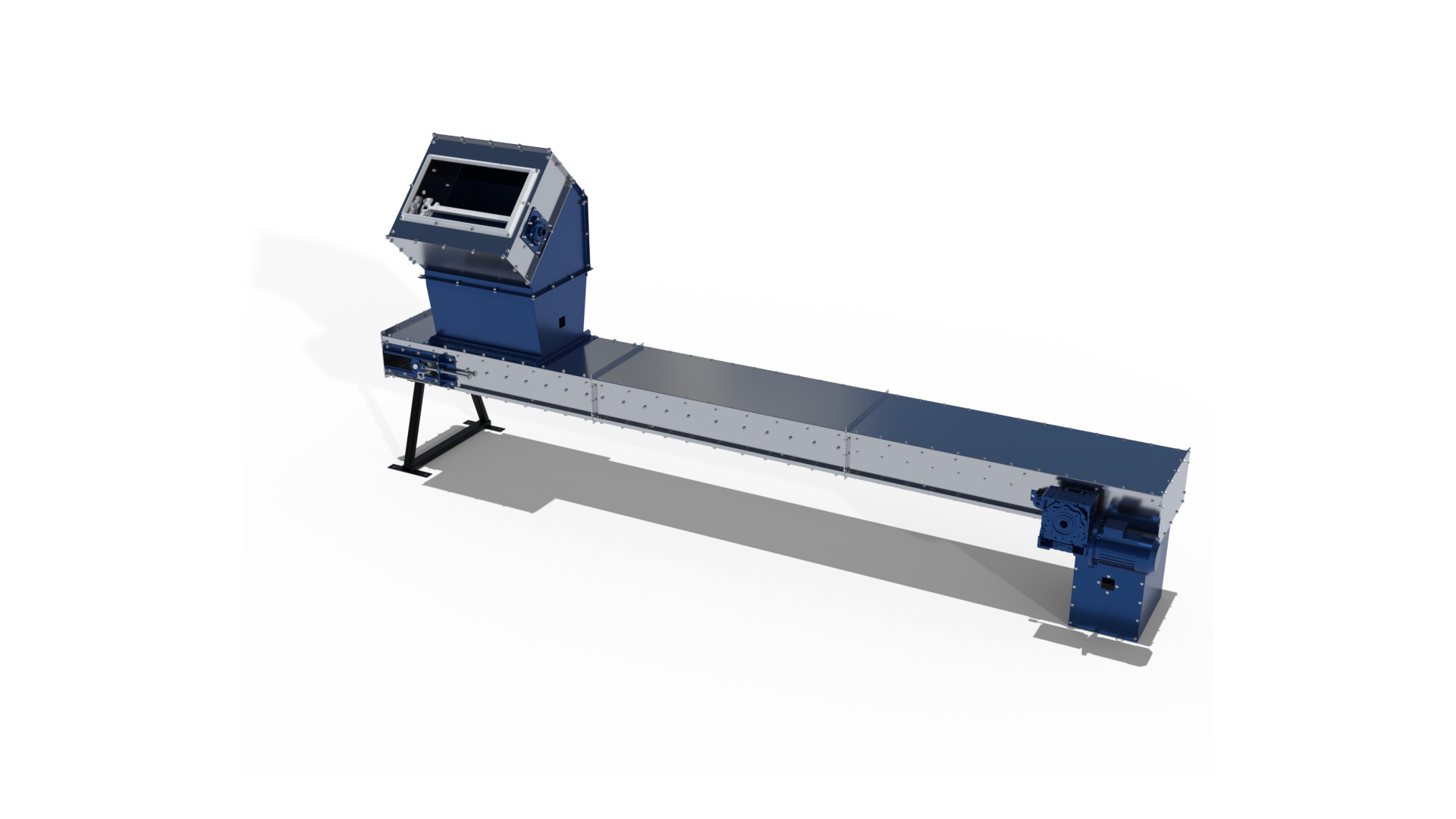
Belt Conveyors
Machine Purpose
A belt conveyor is a continuous-type transport device that performs the following functions:
Transport of bulk materials, i.e., grain, biomass, sawdust, pellets, coal
Production process automation as reduction of manual work and physical effort
Capacity increase, i.e., continuous and timely raw material delivery to required nodes
Operating cost reduction, i.e., energy efficiency relative to capacity
Transport in warehouses and logistics as efficient goods movement between zones
Operating Principle
The machine works on the principle of a closed belt loop stretched around two drums – drive and return:
Electric motor sets the drive drum in motion through friction force
Material loaded at loading point via hoppers and chutes
Carrying rollers (idlers) support the belt and create a U-shape to increase capacity
Tensioning system maintains proper belt tension ensuring effective force transmission
Material transport from point A to point B on the upper belt part
Unloading – material dropped at belt end (by gravity or scrapers)
Belt returns to starting point (closed circuit)
Technical Specification
Conveyor operates at speeds of 4-51 m/min and can work at angles up to 30° standard, 60° for incline.
Main Components:
2 drums (drive and return)
Conveyor belt (rubber, PVC, polyurethane, silicone)
Carrying and centering rollers
Tensioning system
Electric motor
Frame of steel, aluminum, or stainless steel
Parameter Ranges:
Speed: 4-51 m/min
Dimensions: up to 6000+ mm (length), up to 1000 mm (width)
Power: 0.37-75 kW
Inclination angles: 0-30° (standard), up to 27° (special)
Capacity: up to 600 t/h (for large systems)
Construction Materials
Frame and base:
Powder-coated steel (various RAL colors)
Stainless steel (for aggressive conditions)
Aluminum (modular solutions)
Conveyor belt:
Core: Polyester-polyamide fabric plies (3-4 layers)
Rubber covers: upper (thicker, up to 3 mm) and lower (thinner)
Belt materials: PVC, polyurethane, rubber, silicone, felt
Thickness asymmetry: should not exceed 3:1
Drive elements:
Drive and return drums (steel)
Carrying rollers (rubber or steel)
Shafts (high-carbon steel)
Applications in Individual Industries
Agricultural Industry
Transport of grain, seeds, seed materials. Transport of animal feed. Pellet production lines. Self-cleaning (ensuring variety purity).
Wood and Biomass Industry
Transport of sawdust, chips, wood shavings. Heating boiler biomass feeding. Pellet production systems. Transport over significant distances (preferred over screw conveyors).
Energy
Transport of biomass to heating boilers. Energy installation feeding. Coal transport in power plants. Fuel transport (sawdust, pellets, chips).
Chemical Industry
Transport of powders and granules. Transport of bulk materials. Transport of substances that can stick to belt (sludge, sugar, greases). Possibility of mounting cleaning devices (brushes, knives, scrapers).
Construction Industry
Transport of aggregate (sand, gravel, stone). Transport of building materials. Feeding production equipment (concrete mixers, mixers). Storage at construction sites. Transport of huge amounts of raw materials in gravel pits and quarries.
Recycling and Waste Management
Waste sorting and transport. Secondary material transport. Municipal waste processing. Post-production and construction waste transport. Light packaging transport (film, paper, Tetrapak, PET). Bunker systems with hoppers. PA type conveyors – for heavy materials. PL type conveyors – for light packaging materials.
Mining and Quarries
Excavated material transport (coal, metal ores). Transport from underground mines. Transport in surface mining.
Logistics and Warehousing
Production lines. Logistics and distribution centers. Sorting plants and distribution stations. Cooperation with industrial robots and vision systems.